Some of the stories we've projected onto the stars.
A working collection of the tales different peoples have read into the same stars – a starting point for getting to know the night sky.
Every culture that looked up long enough drew lines between the brighter stars and gave the resulting shapes names. The figures the modern astronomical community settled on – eighty-eight constellations, codified by the International Astronomical Union in 1922 – are mostly Greek, with a scattering of southern-sky additions from early-modern European navigators. But they sit on top of older Babylonian patterns, which themselves borrow from still-earlier Sumerian ones, and they coexist with entirely separate constellation systems from China, India, Polynesia, the Americas, and the San and Aboriginal Australian traditions.
The same stars, in other words, have been many different figures. Orion is a hunter to some, a hunter's belt and not the hunter to others, a canoe in parts of the Pacific, and a shrimp in parts of Brazil.
The Great Bear and the Cosmic Hunt
Ursa Major · from Siberia to the Americas
The seven bright stars we call the Big Dipper or the Plough are, across an astonishing stretch of the world, a bear. The Greeks knew them as Callisto, a nymph turned into a bear by a jealous goddess and flung up among the stars. But peoples on the far side of the Atlantic who never met a Greek saw a bear too. Among the Iroquois and other northeastern nations, the bowl of the Dipper is the bear and the three stars of the handle are hunters chasing it across the sky – and when they wound it each autumn, its blood drips down and turns the forest leaves red.
Because the same hunt is told from the Basque country to Siberia to the woodlands of North America – on both sides of the Bering land bridge – comparative mythologists (notably Julien d'Huy) argue it may descend from a single tale carried by Ice Age peoples more than 15,000 years ago. If so, it is one of the oldest stories we can still hear.
The Seven Sisters and the One Who Hid
The Pleiades · almost everywhere
A small, misty knot of stars in Taurus, the Pleiades are one of the few clusters nearly every culture noticed and named. Remarkably often they are seven young women: the seven daughters of Atlas in Greece, fleeing the hunter Orion who still pursues them across the sky; and a group of sisters in Aboriginal Australia, also chased by a man – a story strikingly parallel to the Greek one, on the opposite side of the planet.
Stranger still, many traditions count seven sisters, yet only six stars are easy to see. Many cultures have a "lost Pleiad" – a sister who hid, died, or was carried off. Two astronomers, Ray and Barnaby Norris, have noticed that two of the stars, Atlas and Pleione, have drifted together over time, and would have stood more clearly apart around 100,000 years ago. If the stubborn count of seven is a memory of how the cluster once actually looked, the Seven Sisters would be the oldest story humans still tell.
The Silver River: the Weaver and the Cowherd
The Milky Way, with Vega and Altair · China
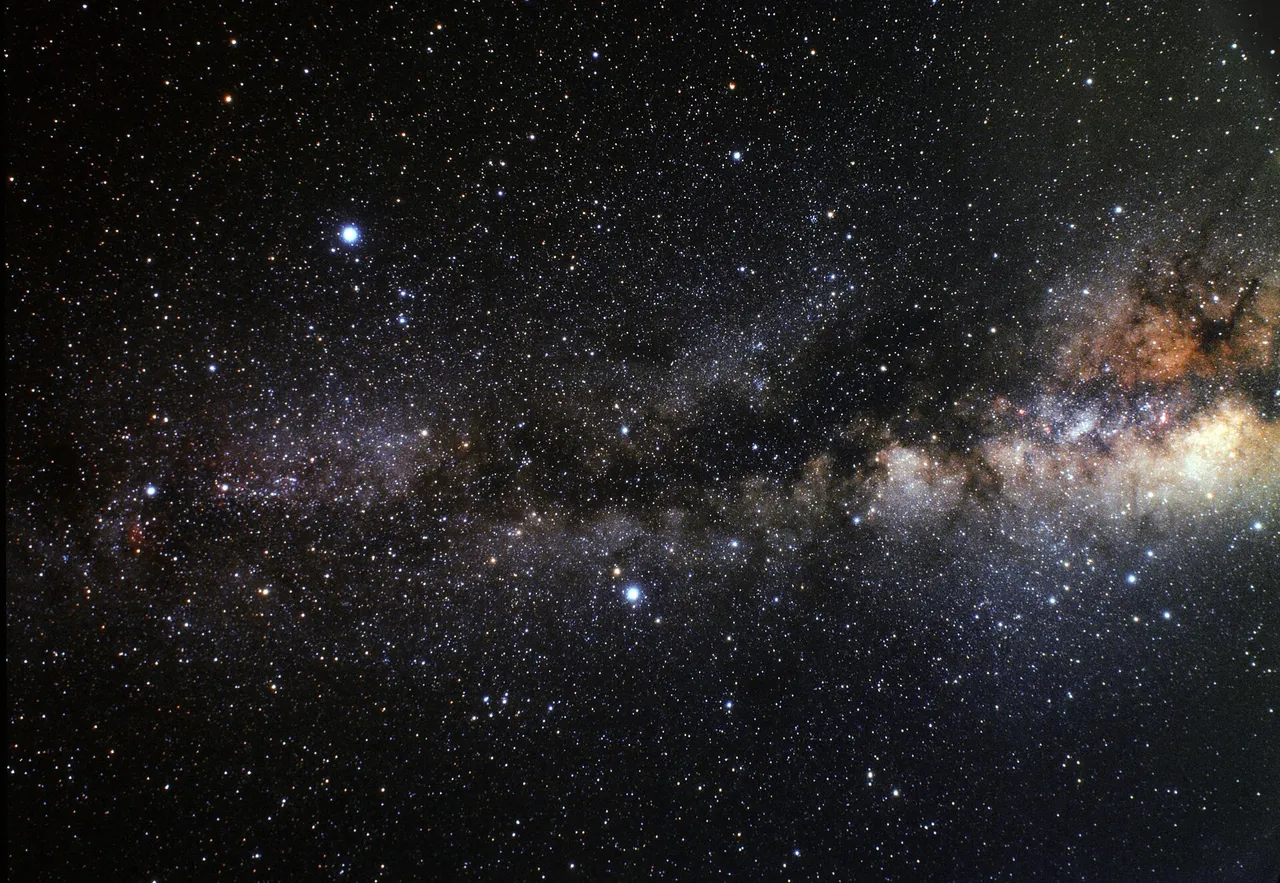
To Chinese eyes the Milky Way was a great Silver River spanning the heavens, and on either bank sat two lovers turned to stars: Zhinü the weaver girl (the star Vega) and Niulang the cowherd (Altair). Married, then forced apart, they are allowed to meet only one night a year, when a bridge of magpies forms across the river to carry them together. That night – the seventh of the seventh lunar month – is still celebrated as Qixi, China's festival of lovers.
The Emu and the Llama in the Dark
Dark constellations · Aboriginal Australia and the Inca Andes
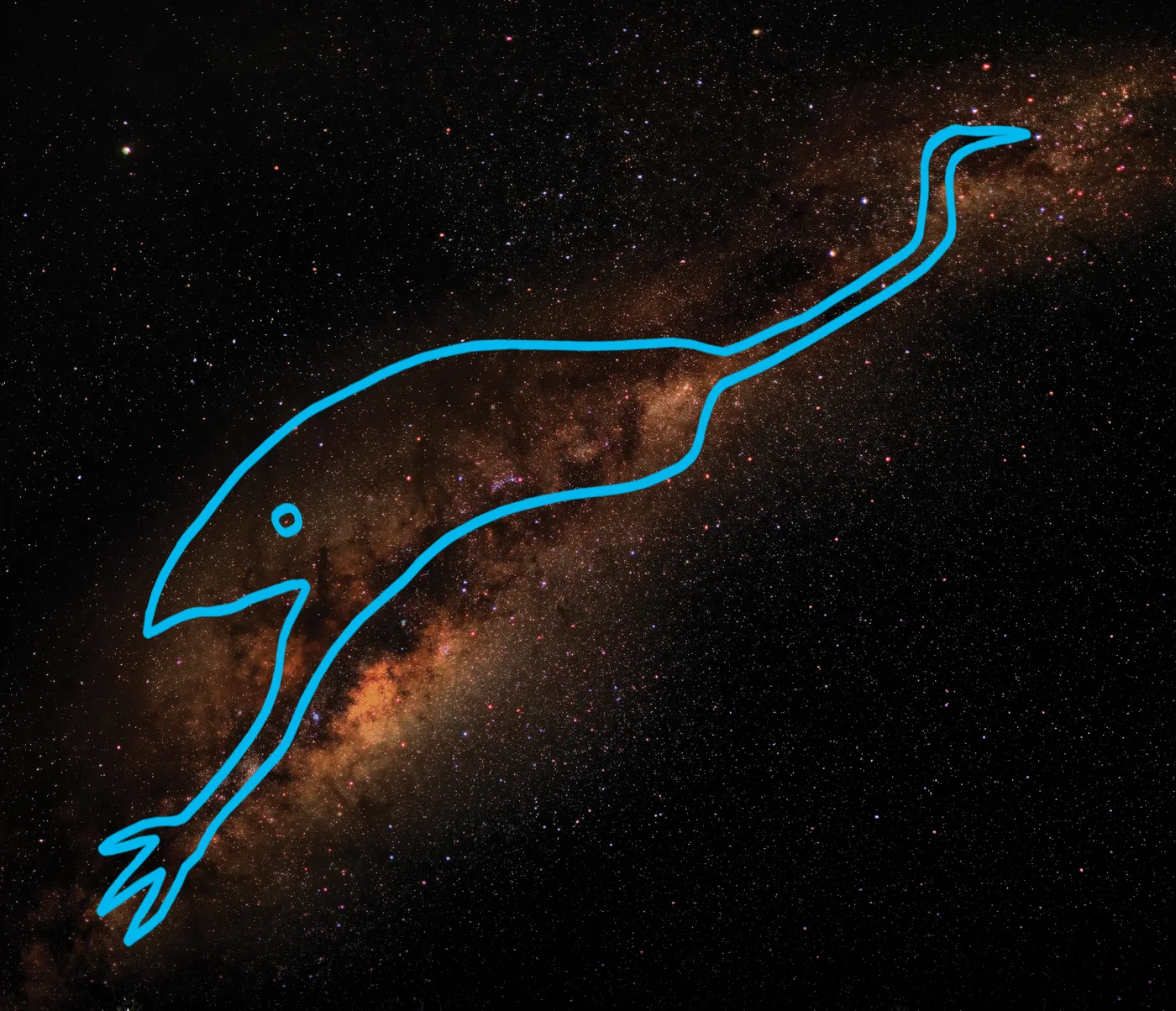
Most traditions draw their figures by joining bright stars. Several Aboriginal Australian cultures did the opposite and read the dark dust lanes of the Milky Way itself. Reaching out from the Coalsack nebula beside the Southern Cross is the silhouette of an enormous emu – head, long neck, and trailing body – made not of stars but of the black gaps between them.
The emu is also a calendar. As the year turns and its posture in the evening sky shifts, it mirrors the bird on the ground: when the celestial emu seems to run, the real emus are seeking mates; when it lies low, it is the season to gather their eggs.
On the far side of the Pacific, the Inca made the same leap. They too read figures in the dark clouds, and their greatest – Yacana, a celestial llama walking the great river of the galaxy – occupies the very same stretch of darkness as the emu. Where the dark shape needed eyes, two of the sky's brightest stars supplied them: Alpha and Beta Centauri, ringed in the photograph just beside the emu's head. Andean herders said that in the dead of night the llama came down to drink from earthly springs, and that her place in the sky told them when the rains would come. Two peoples who never met, on opposite shores of an ocean, each decided the darkness was the picture – and then drew their animal in the same darkness.
Osiris in the Sky, and the Star that Foretold the Flood
Orion and Sirius · ancient Egypt
For the Egyptians the bright stars of Orion were Sah, the celestial form of Osiris, lord of the dead. Close on his heels rose Sirius, the brightest star in the whole sky, identified with the goddess Sopdet. Sirius mattered enormously: each year it vanished into the Sun's glare for about seventy days, then reappeared just before dawn – its "heliacal rising" – within days of the Nile's life-giving flood. An entire civilization set its calendar by the return of that one star.
The Greeks read the same stars as a hunter – and gave him an enemy. Orion boasted he would slay every beast on Earth, so a scorpion was sent to sting him, and both were set among the stars on opposite sides of the sky, where they can never meet. The myth encodes a real piece of celestial clockwork: as Scorpius rises in the east, Orion slips below the western horizon – the hunter fleeing his killer around the sky, forever. And on the far side of the world, that scorpion is no scorpion at all.
Māui's Fishhook
Scorpius · Polynesia and Aotearoa
The long curving tail the Greeks saw as a scorpion is, across Polynesia, unmistakably a fishhook. It is Te Matau a Māui – the hook of the demigod Māui, who used it to haul a giant fish up from the seafloor. That fish became land: the North Island of New Zealand is still called Te Ika a Māui, "the fish of Māui." For ocean-going navigators the hook was also an instrument; its angle above the horizon helped tell them where, in the vast Pacific, they were.
The Bull of Heaven
Taurus · Mesopotamia
Many of our constellations are older than Greece. The Babylonians, building on still-older Sumerian patterns, mapped a band of figures along the Sun's path – the ancestor of our zodiac. Among the oldest is the Bull, Taurus, whose V-shaped face (the Hyades) and red eye (Aldebaran) have glared down since the Bronze Age. In the Epic of Gilgamesh the goddess Ishtar looses the Bull of Heaven to destroy the hero, who kills it instead – a duel some have read into the sky beside the neighbouring "hero" figure of Orion.
The Royal Family of the Autumn Sky
Cassiopeia, Cepheus, Andromeda, Perseus, Pegasus (and Cetus) · Greece
Most constellations carry a story of their own. The northern autumn sky carries something rarer: one story told across six of them, a royal drama spanning a vast sweep of the heavens. Queen Cassiopeia boasted that she – or, in some tellings, her daughter – outshone the sea-nymphs, and Poseidon sent the sea-monster Cetus to ravage the kingdom's coast. An oracle told King Cepheus that only the sacrifice of his daughter would appease it, so the princess Andromeda was chained to the rocks. Perseus, flying home from slaying the Gorgon Medusa, found her there, turned the monster to stone with the severed head, and married her. Even the winged horse Pegasus belongs to the tale, sprung from the Gorgon's blood. Queen, king, princess, hero, horse and monster were all set among the stars together.
The connections are drawn into the figures themselves. Andromeda hangs by her head from the Great Square of Pegasus: the corner star Alpheratz serves as both the princess's head and part of the horse – the boundary-makers gave it to Andromeda in 1930, but its Arabic name still means "the navel of the horse." In Perseus, the hero carries Medusa's severed head, marked by the star Algol – from the Arabic ra's al-ghūl, "the demon's head" – which really does wink: every two days and twenty-one hours a companion star eclipses it and it visibly dims for a few hours. Whether ancient skywatchers noticed the demon star's winking is debated; the name is suggestive.
Cassiopeia received a queen's punishment: chained to her throne, she circles the celestial pole forever, hanging upside down for half of every turn. And the chained princess holds a quiet prize for modern eyes – the Andromeda galaxy, drawn in the chart at its true apparent size: about six full Moons end to end, though only its bright core shows without a dark sky. At two and a half million light-years it is the most distant thing the naked eye can see, and one of the deep-sky objects drawn on the Heaven and Earth dial. The sea-monster pushes its head up over the frame's lower edge: the sprawling, dim constellation Cetus, down in the watery region of the sky. And the monster answers the hero's winking star with one of its own – Mira, "the Wonderful," whose slow pulsing, first recorded in 1596, swells it to easy naked-eye brightness and snuffs it out again on an eleven-month cycle. Algol winks in hours; Mira, in seasons.
The Queen's Hair
Coma Berenices · Hellenistic Egypt, c. 245 BCE
Of all eighty-eight modern constellations, only one still carries the name of a real, historical person. When Queen Berenice II of Egypt's husband went off to war, she vowed to cut off her famous long hair and lay it on an altar if he returned safely. He did; she kept the vow. But the next morning the offering had vanished from the temple. To defuse the scandal, the court astronomer Conon of Samos announced that the gods had been so pleased they had set the queen's tresses among the stars – and pointed to a faint shimmer near the tail of Leo, which we still call "Berenice's Hair."
The Seven Sages and the Faithful Wife
Ursa Major, with Mizar and Alcor · India
In India the same seven stars of the Great Bear are the Saptarishi, the seven great sages of ancient lore. Beside Mizar, the middle star of the handle, sits a tiny companion, Alcor – a classic test of keen eyesight. In Indian tradition Mizar is the sage Vasishtha and faint Alcor is his devoted wife Arundhati, held up as the very model of marital fidelity. To this day some Hindu weddings include a moment in which the couple are shown the Arundhati star.
The Nail of the Sky
Polaris, the North Star · northern Eurasia
The whole northern sky wheels through the night, but one star barely moves: Polaris, almost exactly above the pole. Peoples across the far north turned that stillness into a single idea – the star is a nail, or a stake. To Sámi and Finnish tradition it is the nail that pins up the sky. To Mongolian and Central Asian peoples it is the Golden Stake, Altan Hadaas, to which the horses of heaven – the surrounding stars – are tethered, circling it all night long.